Most people land on this page after paying for at least one treatment that failed to hold. That is not bad luck. If growth returns, the diagnosis was wrong or missing, because the building conditions driving it were never dealt with. Fixing that gap is the whole basis of our service.
One connected engagement rather than a survey here and a clean there. We take the property from cause identification through remediation, environmental stabilisation and final hygiene verification under a single scope.
A large share of our Northern Ireland workload is now properties where other firms have already had a go. The wall was wiped, something was sprayed, and the growth was back before the invoice was filed.
The cause is nearly always identical. Nobody measured the moisture, checked the ventilation or looked at how the building was performing. The stain got treated while the conditions that grew it were left running.
Closing that gap is precisely what we are for.
This is not a cleaning product. It is a structured remediation engagement: find the contributing factors, stabilise the environment, cut the recurrence risk and prove the outcome with measurements.
Across the properties we attend in Northern Ireland, the same five drivers appear again and again. Working out which are present, and how they combine, comes before any treatment decision.
Ongoing humidity imbalance
Relative humidity held above the 40 to 60% band for long stretches, keeping surfaces damp enough for spores to establish.
Ventilation deficiencies
Extract fans that are too small, blocked or switched off for the way the home is actually occupied. Moist air has nowhere to go.
Cold bridging
Typical of NI extensions and exposed gable walls. Cold surfaces drop under the dew point and condense water from the room air.
Heating control limitations
Short heating bursts let surfaces cool and re-warm over and over, wringing fresh condensation into the same rooms each cycle.
Hidden moisture within materials
Soaked plaster, masonry or insulation concealed behind finishes, found only with capacitance, pin and thermal instruments.
Nothing is remediated until the building has been read properly. The diagnostic assessment tells us how moisture is behaving, and only then do we treat, stabilise and verify.
Moisture mapping
Pin, pinless and masonry-comparison readings across the affected and neighbouring areas produce a map of where moisture actually sits.
Pin · Pinless · Masonry
Dew point vs surface temperature
Surface temperatures are checked against the calculated dew point for the prevailing humidity. Below dew point means active condensation.
Condensation Risk Output
Airflow evaluation
Ventilation performance checked against Technical Booklet K requirements. Extract rates, fresh-air provision and stagnation zones room by room.
Technical Booklet
Thermal imaging correlation
Infrared imagery is read alongside the moisture and dew point data, exposing cold bridges, missing insulation and hidden moisture routes.
Annotated Thermal Record
Environmental readings
Logged humidity, temperature and ventilation data from the property itself. This is the baseline every post-works result is judged against.
RH · Temp · Vent Evidence
Plenty of moisture firms exist to fit a system: PIV units, pressurisation kit, vents. We fit nothing, so our report is an investigation, not a sales route.
That independence is the core of the service. Nothing in our diagnosis is shaped by hardware we would need to sell to get paid.
Our reports are investigative documents, never product brochures.
Where ventilation genuinely needs upgrading, we specify the required capacity and the reasoning, and you commission it through any contractor you choose.
The advice stays independent, measured and centred on the diagnosis rather than on a system sale.
Investigation, works and verification stay in one engagement because splitting them between firms is how causes get lost. The aim is not a mould-free week; it is a property that stays clear.
Individually scoped engagement
Pricing is confirmed once we understand the property, its location, the reporting needs and the remediation route required.
Assessment, remediation, stabilisation and verification sit under one scope. This is not surface cleaning and not an inspection-only call. The job is to identify what is feeding the growth, correct the environment and cut recurrence risk against documented evidence.
On-site Diagnostic Assessment
Instrumented investigation of moisture behaviour, ventilation, dew point and environmental conditions across the property.
Root Cause Identification
The drivers are named and evidenced in writing before any works start.
Antimicrobial Remediation
Containment, contamination removal and substrate restoration carried out to the ANSI/IICRC S520 standard.
Post-Remediation Antimicrobial Treatment
Affected surfaces and substrates treated to neutralise whatever contamination remains after removal.
Environmental Stabilisation
Humidity, ventilation and temperature corrected back into specification, removing the conditions that fed the growth.
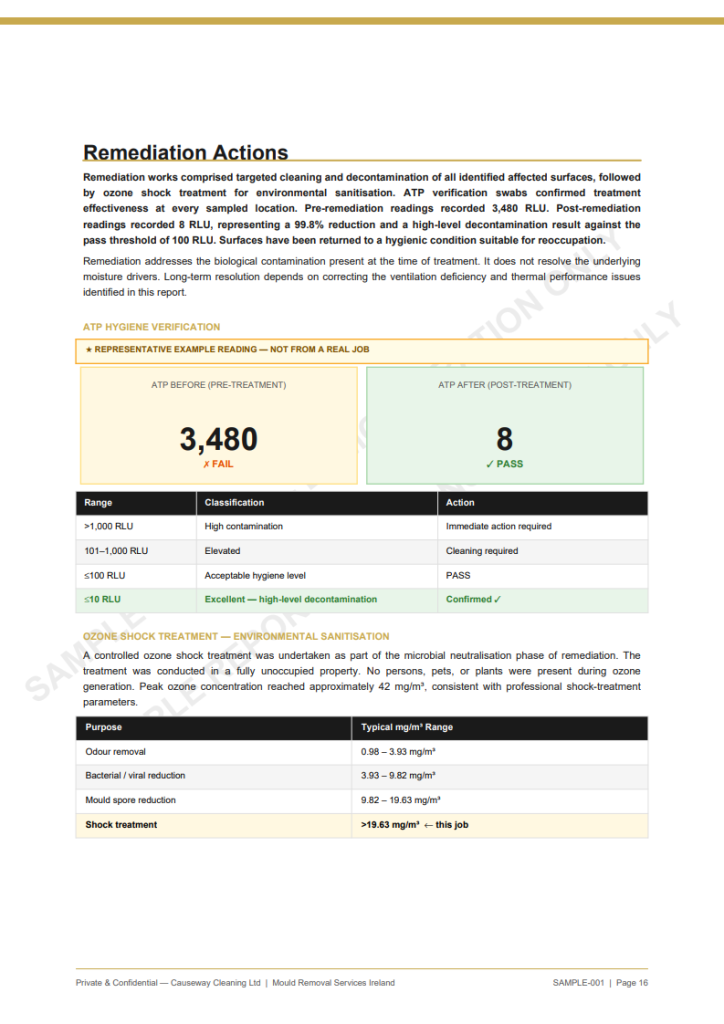
ATP Hygiene Verification — Before & After
Hygiene measured at the start and again at the finish. Sign-off happens only against the documented results.
Full Property Sanitisation
Extended through the affected parts of the building wherever the diagnosis calls for it.
Compliance-Ready Documentation
A structured report fit for homeowners, landlords, agents and public-sector files in Northern Ireland.
Every job produces a structured record: moisture behaviour, findings, works completed and the measured verification behind sign-off. Reading a sample is the quickest way to see the distance between this and a cosmetic clean.
Our remediation work follows the recognised standards for mould, moisture and building performance used across the UK, documented to a level suitable for social landlords and public bodies in Northern Ireland.
ANSI/IICRC S520
The Mould Remediation Standard: the benchmark reference for assessment, containment, removal and verification.
BS 5250
Moisture in Buildings: the code of practice that guides how we assess and resolve condensation risk.
Technical Booklets C, K & F
Resistance to moisture, ventilation and conservation of fuel under the Building Regulations (Northern Ireland).
Structured, compliance-ready remediation for housing associations, councils and property managers across Northern Ireland, documented to public-sector standards.
The process is aligned with recognised environmental and restoration standards and delivered to a documented professional standard.
Some properties need extra stabilisation. Both options below are installed during the service visit, so ask for them when booking.
Light-Activated Anti-Mould Protective Coating
A coating applied after works to discourage regrowth on higher-risk surfaces. It activates under natural or artificial light, and dedicated activation lighting can be added where rooms are dark.
— External walls & window reveals
— Wardrobes and enclosed spaces
— Bathrooms and high-humidity areas
— Reduces regrowth risk on treated surfaces
Must be requested before scheduling — applied during the service visit.
Discreet Post-Remediation Data Loggers
For rentals, second homes or plain peace of mind, discreet loggers track how the property behaves after works and confirm humidity is holding in the safe range.
— Humidity and temperature trends, logged
— Identification of ongoing moisture risks
— Documented environmental evidence
— Supports landlord, manager & compliances cases
Monitoring equipment is installed during the service visit — please request in advance.
We find what is driving the growth, carry out the works and hand you a clear record of what was done and what the readings prove.
+44 2895 600 105
info@mouldremovalbelfast.co.uk
The Mount, 2 Woodstock Link,
Belfast, BT6 8DD